Custom Travel Itinerary! WeChat/WhatsApp: +8613811531028
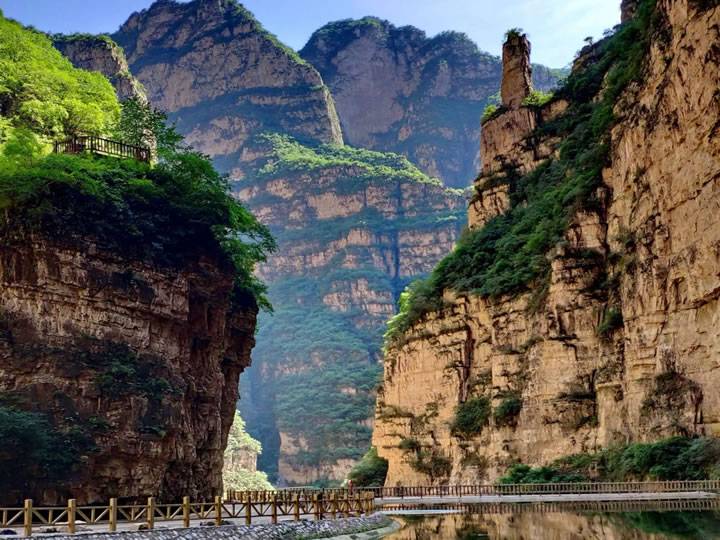
The Nanshiyang Grand Canyon Scenic Area, developed around the Nanshiyang Gully, is located on the western edge of Beijing, along the Yongding River, at the foot of the Great Wall, in the northern part of Mentougou District, within the boundaries of Yanchi Town. The canyon stretches over 20 kilometers, and the scenic area covers approximately 40 square kilometers. The area is divided into "one canyon, nine valleys, eighteen bends, and seventy-two nodes," making it a popular tourist destination for landscape photography, science education, biological research, red tourism, and mountain hiking. The canyons, unique peaks, and cliffs create a rich geological landscape that is majestic, wondrous, perilous, and secluded. Although the Nanshiyang Grand Canyon is a rocky, sea-like landscape, it also boasts a diverse array of flora and fauna, including many rare and exotic plants. These include wild kiwifruit trees over a century old, perennial asparagus, arisaema, aconite, artemisia, wild lilac, scutellaria, polygala, saposhnikovia, glehnia, and stone flowers, among other economically valuable plants. Gentle slopes also feature coniferous or mixed coniferous and broad-leaved forests. Wild animals include mountain rabbits, pheasants, badgers, and grass snakes. Nanshiyang and Beishiyanggou were historically known as Nanxiyanggou and Beixiyanggou, respectively. The Nanshiyang Grand Canyon Scenic Area boasts a rich historical and cultural heritage. It features sections of the Great Wall: the Northern Qi Great Wall west of Dacun and on Nanshan; the Nanshiyanggou entrance (Xikouzi) and Beishiyanggou entrance are the Ming Dynasty Inner Great Wall's Juyongguan system, specifically the Nanshiyangkou and Beishiyangkou entrances; Dacun is the Changyukou entrance; and there are also Changyuxikou, Fangliangkou, and other entrances. On the southern mountain of Shuitou Village to the north of the scenic area, there is a model section of the Great Wall called Yuanchengzi. There is also a Liao Dynasty dressing table, and not far away is a phoenix-turning-back formation. Ancient trails abound: besides the Xixi Ancient Trail, the Forty-Five Ridges Ancient Trail from Dacun to Qinyukou, and the Dazhen Ancient Trail from Dacun to Zhenbiancheng, Nanshiyangou itself is an ancient trail leading to Huailai, Luzishui, and Xiangyangkou. Jiuhegou is also an ancient trail. Ancient legends and magical stories are associated with places like the Niangniang Temple, Sanqing Hall, Sanguan Hall, Xiuzhen Cave at the Great Wall, Desheng Temple in Dacun, Shanshen Temple in Shanshenmiao Village, Longwang Temple in Fangliang Village, Shangfang Temple in Luzishui, and Dabeiyan Guanyin Temple (Gaibuyan) in Xiangyangkou. During the Anti-Japanese War, Tizitou was the office of the Changwanhuai Joint County Government, and Gaibuyan was the gun repair shop of our army. During the Pingjin Campaign of the Liberation War, some deserters of the Kuomintang 104th Army fled along Jiuhegou and were intercepted and captured by the village militia of Qingbaikou and other villages. There are also red sites in the valley, such as the former site of Jiao Ruoyu, the former mayor of Beijing and county magistrate of Wanping County, who fought against the Japanese.